
On May 7, 2026, ChatGPT introduced a subtle but important change. Brand names that had previously appeared without hyperlinks started turning into clickable links inside the ChatGPT chat interface, coinciding with the rollout of self-serve ad support in the US.
In one line
Before May 7, 2026, ChatGPT mentioned brands in its answers but did not hyperlink their websites. Now, it can hyperlink a brand’s homepage directly inside the answer, turning AI mentions from a brand-awareness signal into a measurable acquisition path.
The moment we noticed
The first clue was not a press release. It was a line in LLMLab that stopped looking normal.
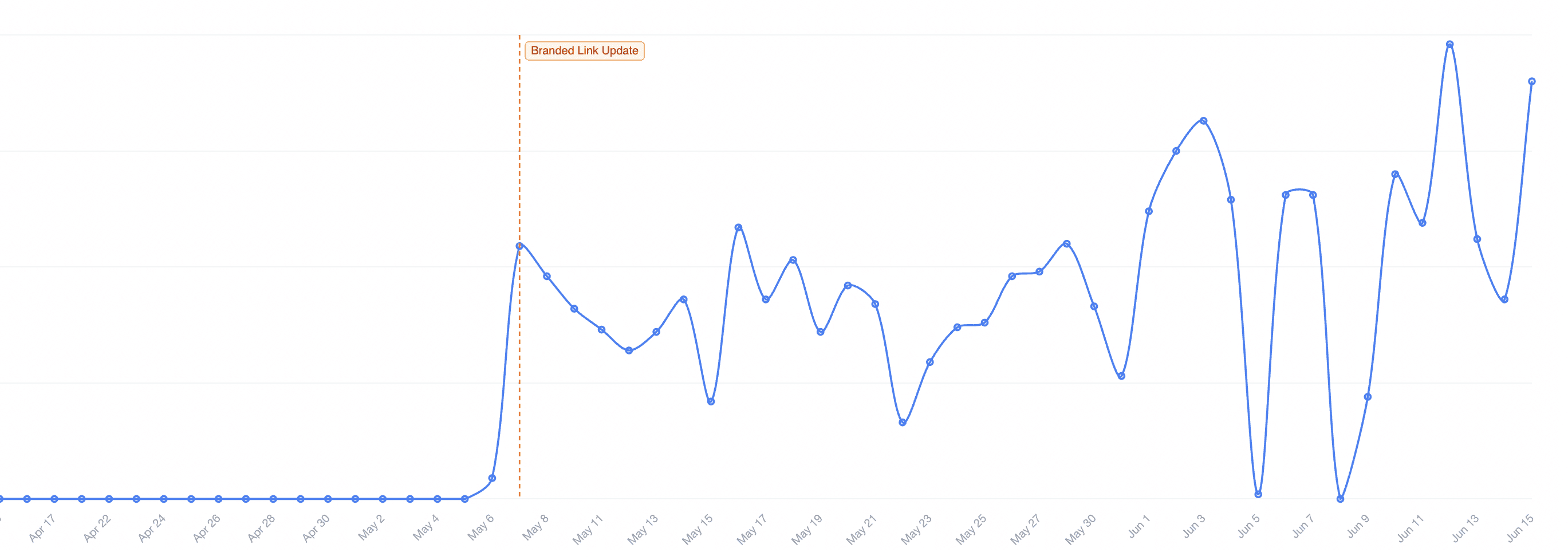
LLMLab tracked a clear break around May 7, marked above as the Branded Link Update.
The spike mattered, but the more important part was what happened after it. The line did not simply fall back to the old baseline. The behavior held, which made it worth tracing.
For weeks, the baseline had been almost too clean. Then May 7 arrived. One day looked different. The next day still looked different. After a few more checks, it stopped feeling like noise and started looking like a product change.
So we worked backwards. We checked answer formats, linked brand names, referral patterns being discussed in the market, and whether the same movement showed up outside our own view. The pattern was hard to ignore: ChatGPT had started placing direct branded links inside answers.
What changed on May 7
Before the update, ChatGPT could recommend a brand and still leave the user with no obvious way to reach that brand. The answer might say “use X” or “compare X and Y,” but the brand name itself was often not the path forward.
After May 7, the brand name started doing more work. In many recommendation-style answers, ChatGPT began turning the brand into a link to the brand’s own site, often the homepage. Small UI change. Large marketing implication.
The old path looked like this:
User asks a buying question → ChatGPT recommends a few brands → user reads the answer → maybe searches one of those brands later.
The new path can look like this:
User asks a buying question → ChatGPT recommends a few brands → brand name is clickable → user lands directly on the brand site.
That difference matters because “being mentioned” and “getting traffic” are no longer separate events. The mention can now become the click.
Why this is not just another AI search detail
For the last two years, a lot of AI search discussion has been stuck around zero-click behavior. The fear was simple: AI tools answer the question, the user never leaves, and the brand receives little or no traffic even if it is recommended.
The May 7 shift does not end that debate. It changes the shape of it. ChatGPT can now act less like a closed answer box and more like a referral layer. Not for every query. Not for every category. But enough that marketers should stop treating AI visibility as something that only lives in dashboards.
External research points in the same direction
Profound reported that OpenAI referrals to tryprofound.com jumped 200% overnight on May 7 and held there. They also reported that the homepage share of those referrals more than doubled. Qwairy, looking at more than 140,000 ChatGPT answers, reported that inline brand links jumped roughly 14x on the same day. Different datasets. Same break point.
The interesting part is not just that traffic moved. It is where the links appear to be landing. A lot of the new links point to the brand’s homepage, which means the homepage is no longer only serving people who already know you. It may now be the first page someone sees after ChatGPT recommends you.
The real marketing shift
This update creates a new chain marketers need to measure:
Did ChatGPT mention us for the right buying prompts?
Did the mention include a direct branded link?
Which page did that link send people to?
Did those visitors behave differently from Google, paid, or direct traffic?
Did competitors get linked in prompts where we were only mentioned, or not mentioned at all?
This is where many teams will get the update wrong. They will open Google Analytics, look for a line called ChatGPT traffic, and stop there. That is useful, but it is only the downstream view. The upstream question is still the important one: why did ChatGPT choose to mention and link one brand over another in the first place?
How to check ChatGPT traffic in GA4
Start with GA4. It will not tell you why ChatGPT chose your brand, but it can tell you whether people are already reaching your site from ChatGPT.
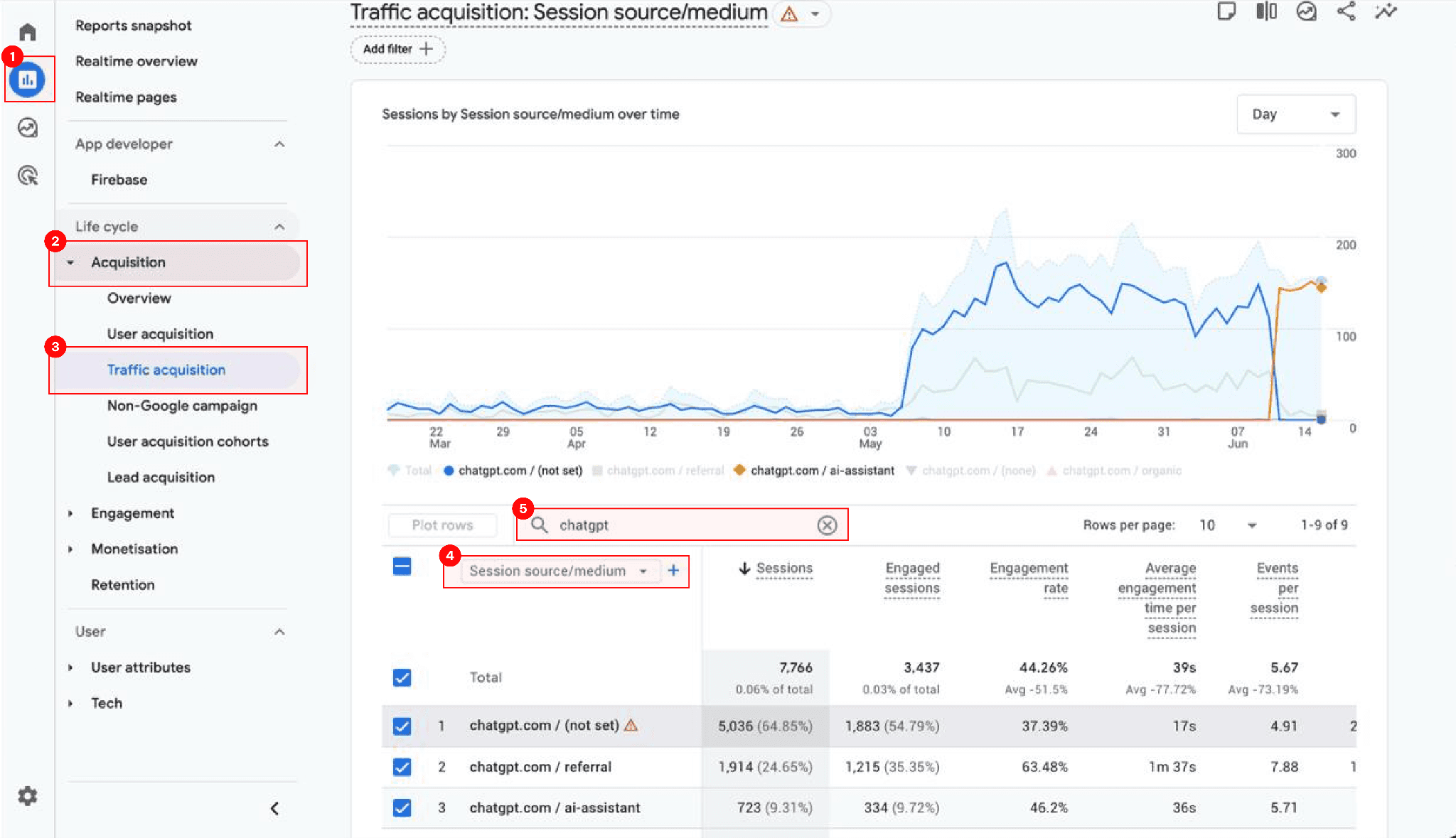
In GA4, search for ChatGPT inside Traffic acquisition using the Session source/medium dimension.
Here is the cleanest path:
Open GA4 and go to Reports.
Under Life cycle, open Acquisition.
Click Traffic acquisition.
Set the table dimension to Session source/medium.
Search for “chatgpt”.
You may see entries such as chatgpt.com / referral, chatgpt.com / (not set), chatgpt.com / ai-assistant, or UTM-tagged ChatGPT sessions. The labels can vary depending on how the visit is passed into GA4 and whether links are tagged.
Do not stop at Sessions. Look at Engaged sessions, Engagement rate, Average engagement time, Events per session, and conversions. A small volume of ChatGPT traffic can still matter if those visitors are arriving with strong intent.
Quick read:GA4 can show the click after it happens. LLMLab helps you understand what happened before the click: which prompts mentioned you, whether the mention was linked, which competitors were shown, and what sources shaped the answer. |
What brands should check this week
1. Segment ChatGPT and OpenAI traffic separately
Do not bury this inside generic referral traffic. Create a simple view for chatgpt.com, openai.com, and any UTM-tagged ChatGPT sessions. Track quality, not only volume.
2. Rework your homepage as an AI landing page
If ChatGPT sends new visitors to your homepage, that page needs to explain who you are fast. Clear category positioning, proof, comparison language, and a visible next step matter more than they did a month ago.
3. Track mention share before link share
ChatGPT cannot link a brand it does not name. The first battle is still getting included in the answer. The link is the next layer.
4. Compare prompts, not only pages
A normal SEO report starts with URLs. AI visibility starts with buying situations. Track the prompts your customers would actually ask before they choose a vendor.
5. Watch competitors by category
This update will not help every industry equally. Categories where ChatGPT recommends companies may benefit faster than categories where it recommends individual products.
What this means for GEO
The May 7 update makes GEO more concrete. Until now, some teams treated AI visibility as a soft metric: nice to have, hard to connect to pipeline. That is changing. Once a model turns a recommendation into a link, visibility begins to behave like a channel.
But lazy GEO will not work. Publishing generic “best tools” content is not a strategy. Brands need to understand how AI systems describe their category, which sources shape the answer, which competitors appear in the same context, and what their own site says when the user finally lands there.
The new rule is simple: if AI tools can recommend you, they can route traffic to you. If they can route traffic to you, you need to measure and optimize the full path.
The LLMLab read
We do not think this is a one-off UI tweak. It is a sign of where AI search is going. Answers are becoming more actionable. Brand recommendations are becoming more attributable. The distance between “the model mentioned us” and “someone landed on our site” is getting shorter.
For marketers, that means AI visibility is moving out of the experimental bucket. It now touches acquisition, attribution, homepage strategy, competitive intelligence, and content planning.
The brands that win here will not be the ones that simply notice a new referral source in analytics. They will be the ones that understand why the answer chose them, why it linked them, and what the visitor saw after the click.
How LLMLab helps
LLMLab helps teams track how their brand appears across AI search engines, compare visibility against competitors, inspect the sources shaping AI answers, and turn those patterns into content and landing-page actions. In a world where ChatGPT can turn a brand mention into a click, that visibility layer becomes infrastructure.